
SM4T
SM4T Software
Multi-agent simulator for multimodal passenger travel
Contact: Mahdi Zargayouna.
Multi-agent simulator for multimodal passenger travel
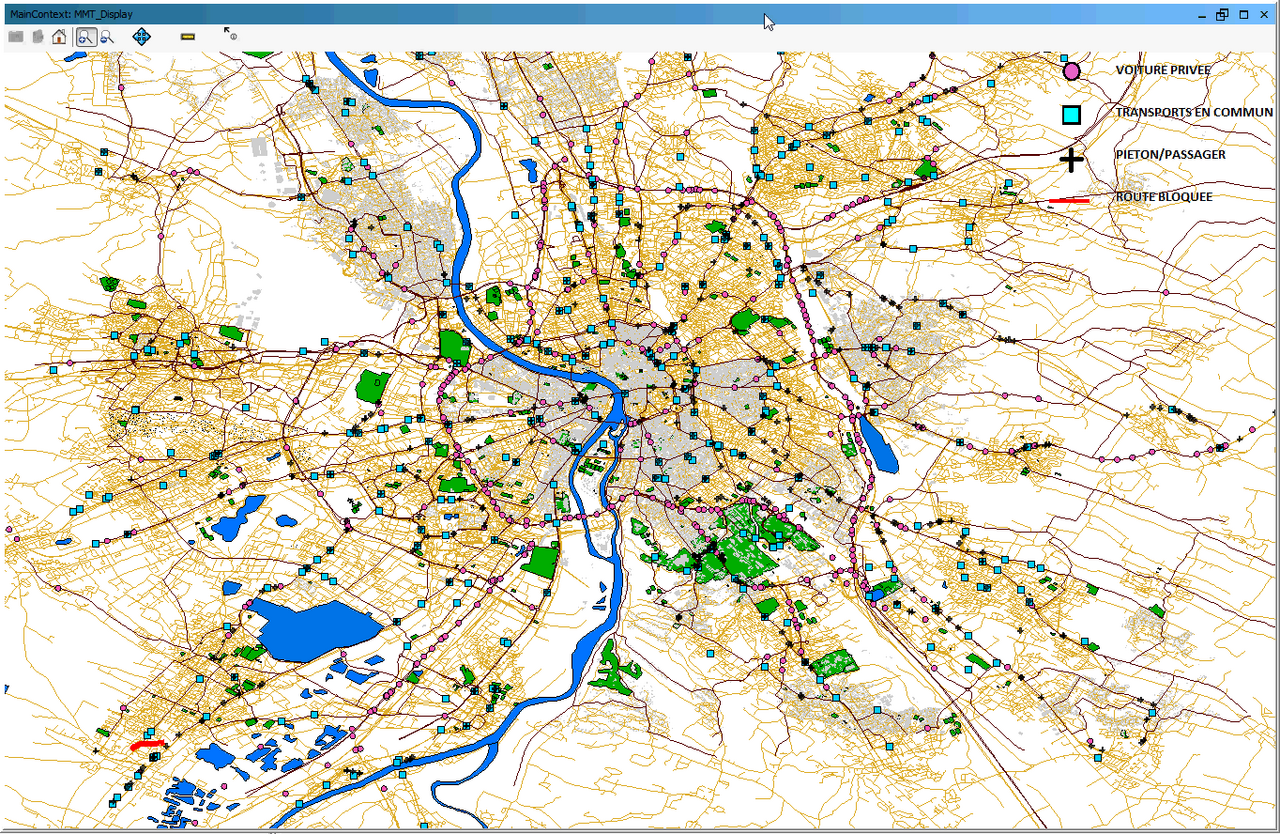
As part of the European Instant Mobility project, we worked on developing a prototype for multimodal travel assistance based on future Internet technologies. The proposed travel optimization system covers planning, monitoring, forecasting, and real-time communication functions. To test this service, we developed the SM4T multi-agent simulator, which replicates the travel patterns of multimodal travelers and drivers, and implemented it using data from the Toulouse metropolitan area. It relies on the multimodal network provided by ClaireSITI,the traffic regulation platforms such as Claire, developed at GRETTIA and industrialized at Thales
Additional and more detailed description of the features
SM4T is developed using the Repast Simphony multi-agent development platform, which is based on the object-oriented Java programming language. The simulator can be deployed as a web service and controlled remotely (start, incremental retrieval of travel data, pause, stop).
To operate, the simulator requires the following parameters.
• A description of the road transport network in the relevant area (XML document, XSD schema provided, positions in WGS 84)
• A description of the public transit network for the area in question
• The number of passengers to be simulated
• The number of drivers to be simulated
• The public transit vehicle schedule
• [Optional] The travel model for the area in question (origin-destination pairs). If this parameter is not provided, origin-destination pairs will be randomly generated.
• [Optional] Average speeds of vehicles and passengers. This parameter is used in case of “gaps” in the description of average speeds on network segments.
• Simulation duration: the number of time steps in the simulation. The granularity of passenger and vehicle movement is proportional to this parameter.
In return, for each step of the simulation, the simulator generates an XML document (XSD provided) that lists the positions and routes of all agents (passengers, drivers, and public transportation vehicles). If the user wishes, the simulator can simulate road closures and their impact on the various routes.